
Eleven companies have launched their initial public offerings (IPOs) in December 2023, making this month the second-best December for public offerings since 1996. Collectively, they are raising Rs 8,182.7 crore this month. In December 2021, 11 companies raised Rs 9,534 crore. However, excluding December 2021, this month marks the best December for IPOs since 1996.

The apex bank also noted that manufacturing activities slowed down in certain parts of the country.

Automobile (auto) retail sales in India grew by an impressive 14 per cent in July compared to the same period last year, driven by a surge in the rural economy, good product availability, and product launches. While passenger vehicles (PVs) saw a 10 per cent increase during this period, inventory levels have surged to a historic high of 67-72 days in PVs, equating to Rs 73,000 crore worth of stock, according to the Federation of Automobile Dealers Associations (Fada). This poses a risk to dealer sustainability. Inventory levels in July 2023 were only 50-55 days, equating to a stock worth Rs 49,833 crore. In June 2024, inventory was between 62 and 67 days, with a stock value of Rs 60,000 crore.

tailwinds of a remarkable year and handsome investor returns, Indian equities are set for an eventful journey in 2024, with a slew of local and global cues -- varying from interest rates to Lok Sabha polls to geopolitical happenings. Analysts are of the view that the bull run in the domestic equity market will continue, and over the next 3-6 months, the benchmark indices -- Sensex and Nifty -- could climb up to 7 per cent. In 2023, the 30-share BSE Sensex jumped 11,399.52 points or 18.73 per cent, and the NSE Nifty climbed 3,626.1 points or 20 per cent.

When the Centre tries to encroach upon the subjects that are under the prerogative of the state, or where the centre tries to evade from any responsibility guaranteed to a state through a constitutional provision/obligation, it poses a threat to federalism.

'Investors should hold equity assets for 3 to 5 years.'

JP Morgan's decision last week to include Indian government bonds in its Government Bond Index-Emerging Markets (GBI-EM) index and the index suite from June 2024 may be a sort of blessing for India, as the move is estimated to result in an inflow of $25 billion of foreign portfolio investments into the country. The development comes at a time when the spread between the benchmark 10-year government of India bond and the 10-year US government bond has declined to its lowest level in more than 17 years. Low yield spreads make Indian bonds less attractive to foreign portfolio investors (FPIs).

With concern on food inflation ebbing with the monsoon progressing well, the Reserve Bank of India (RBI) is warming up to the idea of a change in stance to "neutral" from "withdrawal of accommodation", according to economists. In his speech on Thursday during the annual event of the Federation of Indian Chambers of Commerce and Industry-Indian Banks' Association, RBI Governor Shaktikanta Das said: "The balance between inflation and growth is well-poised."

Yellen, 74, was confirmed by the Senate in a broad bipartisan support of 84-15 votes on Monday. Both the Democratic and the Republican parties have 50 members in the 100-seat Senate.

Attributing to people familiar with the plan, the Financial Times said that SEC and Federal Reserve officials were warned by Merrill Lynch about Lehman's balance sheet calculations as far back as March 2008.

Domestic equity investors' wealth eroded by more than Rs 4.43 lakh crore on Monday as fears of a financial contagion triggered by one of the biggest bank failures in the US roiled market sentiments. After a strong opening, Indian stocks went into a tailspin with the benchmark 30-share BSE Sensex tumbling nearly 900 points to close at 58,237.85 points -- sliding for the third straight trading session. The NSE Nifty too declined 258.60 points to end at 17,154.30 points.

Among Sensex shares, HDFC Bank fell the most by 2.58 per cent, followed by SBI (2.12 per cent), HDFC (2.09 per cent), and IndusInd Bank (2.02 per cent). Axis Bank, Bajaj Finserv, M&M, L&T, Reliance, Infosys and TCS were among the major losers. In contrast, Tata Motors, Maruti, NTPC, Sun Pharma, Power Grid and Titan were among the gainers.

If indeed we want the board to manage the RBI, probably the government should take a close look at the US Federal Reserve system which has a two-part structure - a central authority in Washington, DC, and a decentralised network of 12 Federal Reserve Banks located throughout the country, says Tamal Bandyopadhyay.

A strong and stable dollar is both in the American interest and in the interest of the global economy, US Federal Reserve Board chairman Ben Bernanke said on Wednesday.

Defending champion Novak Djokovic tops the draw while new world number one Ash Barty is top seed in the women's singles.
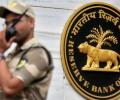
A day after the RBI raised the benchmark lending rate by 35 basis points, Kotak Mahindra Bank Managing Director Uday Kotak on Thursday said the central bank may go for one more rate hike to bring inflation below its upper tolerance level of 6 per cent. Yesterday, the RBI indicated that it wants inflation to be within the band first and then move towards the target of 4 per cent, Kotak said at the CII Global Economic Policy Summit 2022. "My sense is that there could be one more rate hike and that may be the time for thinking about a pivot, but we got to watch very closely the data, and maybe around 6.5 per cent as it looks today, subject to what happens to the world, subject to what happens to oil, subject to what happens to many other things," he said.

With improvement in the housing and manufacturing sectors, the recession-hit US economy has been witnessing signs of stabilisation in recent months, the US Federal Reserve has said.

Equity indices faced a heavy drubbing on Thursday after an initial rally, with Sensex tanking 1,045.60 points amid a largely bearish trend overseas after the US Federal Reserve hiked rates by 75 basis points.

Even though the NIA claims that more than 90 per cent of cases charge-sheeted have ended in conviction, the figure is likely misleading. To date, very few cases investigated by the NIA have resulted in a completed trial, points out former CBI joint director Navneet Rajan Wasan.

The US Federal Reserve has retained the benchmark interest rate at near-zero level and struck an upbeat note saying that the American economy has continued to strengthen in recent months.

Several Aam Aadmi Party leaders, including Manish Sisodia and Sanjay Singh, hit out at the BJP government at the Centre, saying agencies are targeting those who raised their voice against the ruling party.

Stock markets this week would take cues from global trends, the announcement of domestic macroeconomic data such as GDP numbers and foreign fund movement, analysts said. Besides, monthly auto sales and Purchasing Managers' Index (PMI) data for manufacturing and services sectors would also influence trading in the market, they added. Benchmark BSE Sensex tumbled 1,538.64 points or 2.52 per cent last week amid concerns that the US Federal Reserve might raise interest rates further to curb inflation.

'If rate cuts happen, bond yields will come down and investors will make mark-to-market capital gains on them.'

The comment was in response to a June 19 Reuters story citing sources with knowledge of the matter as saying that India planned to clear some oil payments to Iran through the United Arab Emirates central bank.

The state government said these bills had been pending with the governor for as long as about two years and his action "subverted" the functioning of the state legislature, rendering its very existence "ineffective and otiose".

Foreign investors pumped in Rs 11,119 crore in the Indian equities in December, making it the second consecutive monthly inflow, despite increasing concerns over the re-emergence of Covid-19 cases in some parts of the world. However, foreign portfolio investors (FPIs) have turned cautious in recent days. The inflow in December was much lower compared to Rs 36,239 crore invested by FPIs in the month of November, data with the depositories showed.
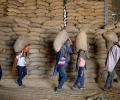
Domestic exporters on Monday expressed concerns over the crisis in Bangladesh and said the developments in the neighbouring country would have implications on bilateral trade. However, exporters expect that the situation may normalise soon. According to exporters, they are already facing disruptions in exports to Bangladesh due to a shortage of foreign exchange in that country.

The recession-hit American economy is slowly witnessing signs of stabilisation, with significant reduction in the pace of GDP contraction and job losses. Going by the latest Beige Book from the US Federal Reserve, economic activity in most of the districts in the country have either improved or stabilised.

Investors are increasingly turning optimistic about shares of new-age companies. From broad-based 'sell' calls, analysts are giving thumbs up to Zomato, Paytm, and FSN e-Commerce Ventures-owned Nykaa as these companies have shifted focus to sustainable profits. The shares of Zomato hit a fresh 52-week high of Rs 126 apiece on the BSE on November 7, having rallied 15.4 per cent in one week.
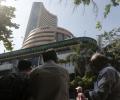
The 50-share NSE Nifty closed lower by 19.25 points, or 0.19 per cent at 10,121.90

'The risk is in not being invested and missing out on an upmove.'

The rupee on Wednesday declined by 16 paise to close at its fresh lifetime low of 77.60 against the US dollar amid unabated foreign fund outflows and a stronger greenback in overseas markets. At the interbank foreign exchange market, the rupee opened lower at 77.57 and later hit the day's low of 77.61 as the dollar rebounded in global markets following hawkish comments from US Federal Reserve chief Jerome Powell. Crude oil prices also surged over 1 per cent, which weighed on the rupee.

"I think the Fed is out of control. I think what they're doing is wrong. Under the Obama administration, you had a lot of help because they had very little interest," Trump told reporters at the White House Thursday while responding to questions on the down sliding of the stock market for a second consecutive day.

The Indian rupee is expected to trade between 80 and 84 against dollar in the first three months of 2023 with support from overseas inflows though worsening current account deficit (CAD) and reduced interest rate differential between the US and India pose challenges. According to a Business Standard Poll of 10 participants, most said the rupee could gain strength in January due to foreign inflows, and the Reserve Bank of India (RBI) is not expected to allow the currency to depreciate ahead of the Union Budget scheduled on February 1. The rupee depreciated 10.15 per cent in 2022, its worst performance since 2013 as the war in Europe and the interest rate increase by the US Federal Reserve prompted investors to flee emerging markets.

The US Federal Reserve has earned a whopping $14 billion profit on loan programmes made in the last two years, says a media report.

Investors' wealth on Thursday tumbled over Rs 2.81 lakh crore as stocks declined in line with selloff in global equities. The 30-share BSE benchmark index tanked 581.21 points or 1 per cent to settle at 57,276.94. During the day, it cracked 1,418.79 points to 56,439.36. In tandem with weak trend in equities, the market capitalisation of BSE-listed firms tanked Rs 2,81,147.38 crore to Rs 2,59,97,419.48 crore.

The rupee appreciated 7 paise to 79.74 against the US dollar in early trade on Thursday as a positive trend in domestic equities supported the local unit. However, a strong American currency overseas and forex outflows restricted the rupee's gain, dealers said. At the interbank foreign exchange, the rupee opened at 79.72 against the American dollar, then went lower to trade at 79.74 against the greenback in early deals, registering a gain of 7 paise over the last close.

A Delhi court on Monday sent Chief Minister Arvind Kejriwal to judicial custody till April 15, noting the Enforcement Directorate's contention that his release could hamper the investigation into the Delhi excise policy-linked money laundering case.

The US Federal Reserve, on Wednesday, announced a 0.25 per cent cut in benchmark interest rate, which is expected to increase capital flow from foreign institutional investors in the Indian stock market.

Benchmark indices fell on Monday with the BSE Sensex declining 306 points, mainly dragged down by Reliance Industries. Foreign funds outflow also added to the overall bearish trend in equities on Monday. The 30-share BSE benchmark fell 306.01 points or 0.55 per cent to settle at 55,766.22. During the day, it declined 535.15 points or 0.95 per cent to 55,537.08. The broader NSE Nifty dipped 88.45 points or 0.53 per cent to 16,631.
